the 1915 record
Alaska City received the most votes.
The reported contest lists Alaska City first with 146 votes, followed by Lane with 129 and Anchorage with 101.
The vote
Nine proposed names appear in later historical summaries of the August 9 contest. Alaska City received the highest reported total; Anchorage is third with 101.
| Proposed name | Votes |
|---|---|
| Alaska City | 146 |
| Lane | 129 |
| Anchorage | 101 |
| Matanuska | 54 |
| Ship Creek | 48 |
| Winalaska | 18 |
| Terminal | 16 |
| Gateway | 10 |
| Homestead | 9 |
Vote rows. David Reamer for Visit Anchorage, The Naming of Anchorage: A Safe Place to Be. Secondary source.
The name was in use.
The reported vote came after Anchorage appeared in the administrative record. The surviving sequence does not identify a single order or prove a conspiracy.
-
Reported later
Mail was directed to Anchorage.
Later sources report that the Post Office Department was using Anchorage and had appointed Roydon Chase postmaster.
-
Survey and auction
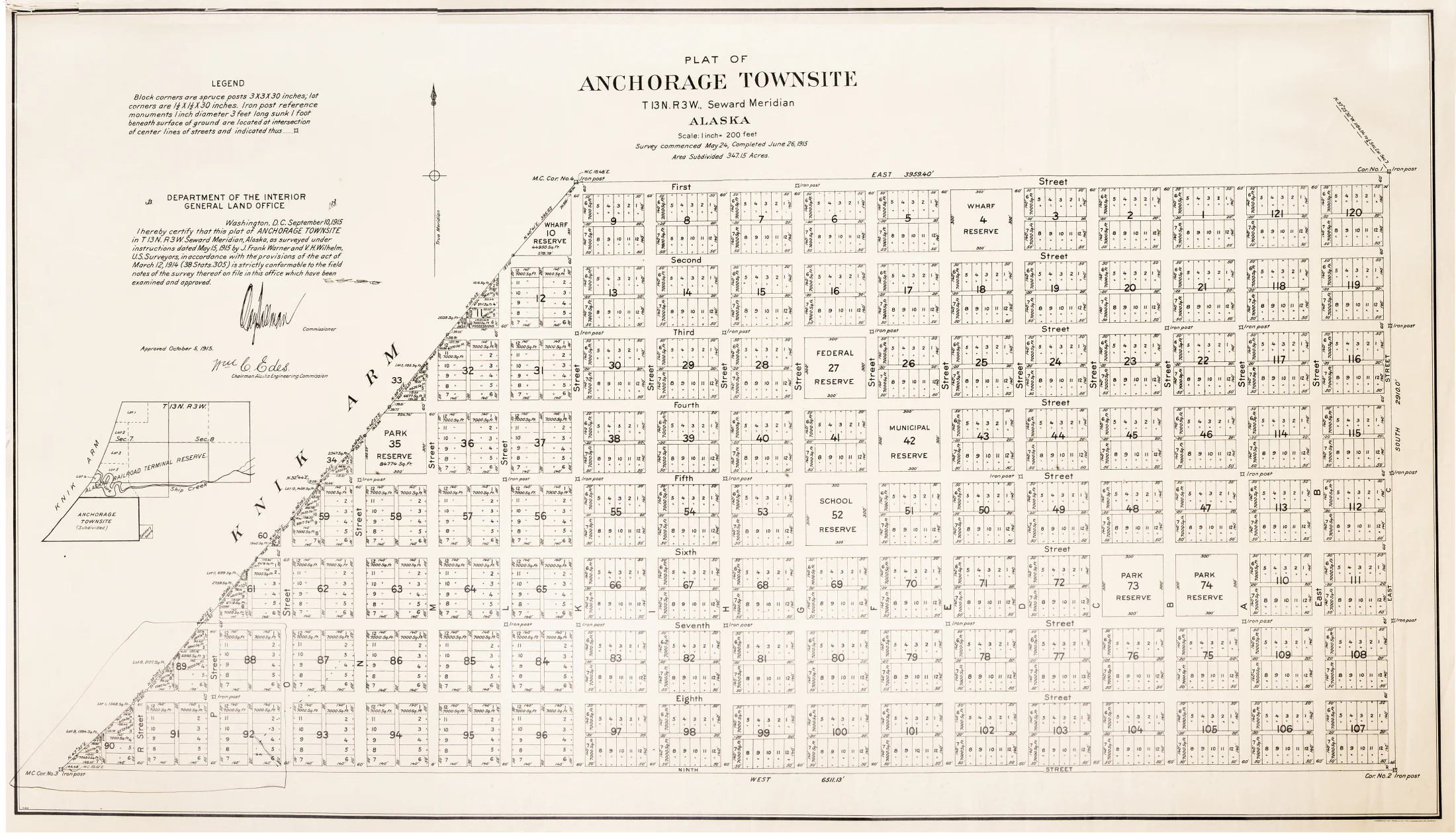
The townsite was surveyed as Anchorage.
The plat records an Anchorage townsite survey for the Alaska Engineering Commission. The first lot auction followed on July 10.
-
Reported vote
Residents gave Alaska City the highest reported total.
Later historical summaries place Alaska City first, Lane second, and Anchorage third. The table preserves all nine reported names and vote counts.
-
Continued use
Anchorage continued through mail and federal administration.
Later sources report continued postal use. The Alaska Engineering Commission also used Anchorage in its official account.
Chronology. Cook Inlet Historical Society; Alaska Engineering Commission; 1915 townsite plat; and the vote sources below.
The place had names before the townsite.
Dena’ina place names record specific relationships with land, water, travel, and use. They are not interchangeable labels for one modern municipal footprint.
- Qatuk’e’usht
- Greater Anchorage area. Visit Anchorage prints Qatuk’e’usht with the gloss Something Drifts Up to It.
- Dgheyaytnu
Dgheyay Leht - Ship Creek. The Anchorage Museum stewardship map presents both names with Ship Creek, glossed respectively as Stickleback Creek and Where Stickleback Run.
- Dgheyay Kaq’
- Mouth of Ship Creek. The Anchorage Museum identifies this place at the creek mouth and gives the gloss Mouth of Stickleback Creek.
Spelling note. The Anchorage Museum stewardship map prints Qatuk’ek’usht. This archive does not assert that the published forms are linguistically equivalent.
Published forms, spelling, and geographic presentation remain open to Dena’ina review. This archive claims no exclusive traditional name or civic designation.
Sources 7-10. Visit Anchorage; Anchorage Museum stewardship booklet; Dgheyay Kaq’; Dena’ina Ełnena.
What the record supports
Documented
- Anchorage appeared in postal and federal records before the contest.
- Later sources place Alaska City first, Lane second, and Anchorage third.
- The settlement continued as Anchorage.
Interpretation
Administrative repetition reinforced Anchorage after the contest. That is an inference, not evidence of a single order or conspiracy.
Unresolved
- The precise legal status of the contest.
- The original tally and contemporary newspaper record.
- The postal order or correspondence.
- The finalization chain by which Anchorage prevailed.
Sources
- Anchorage: Maps and Place Names
Anchorage Museum Education Department, 2019. Postal, voting, and Indigenous context. Secondary source.
- Anchorage Timeline
Cook Inlet Historical Society. Supports the April postal chronology, August contest, lot auction, and continued use of Anchorage. Secondary source.
- Annual Report of the Alaskan Engineering Commission, 1916
U.S. Department of the Interior. Documents federal townsite administration and official use of Anchorage. Primary source.
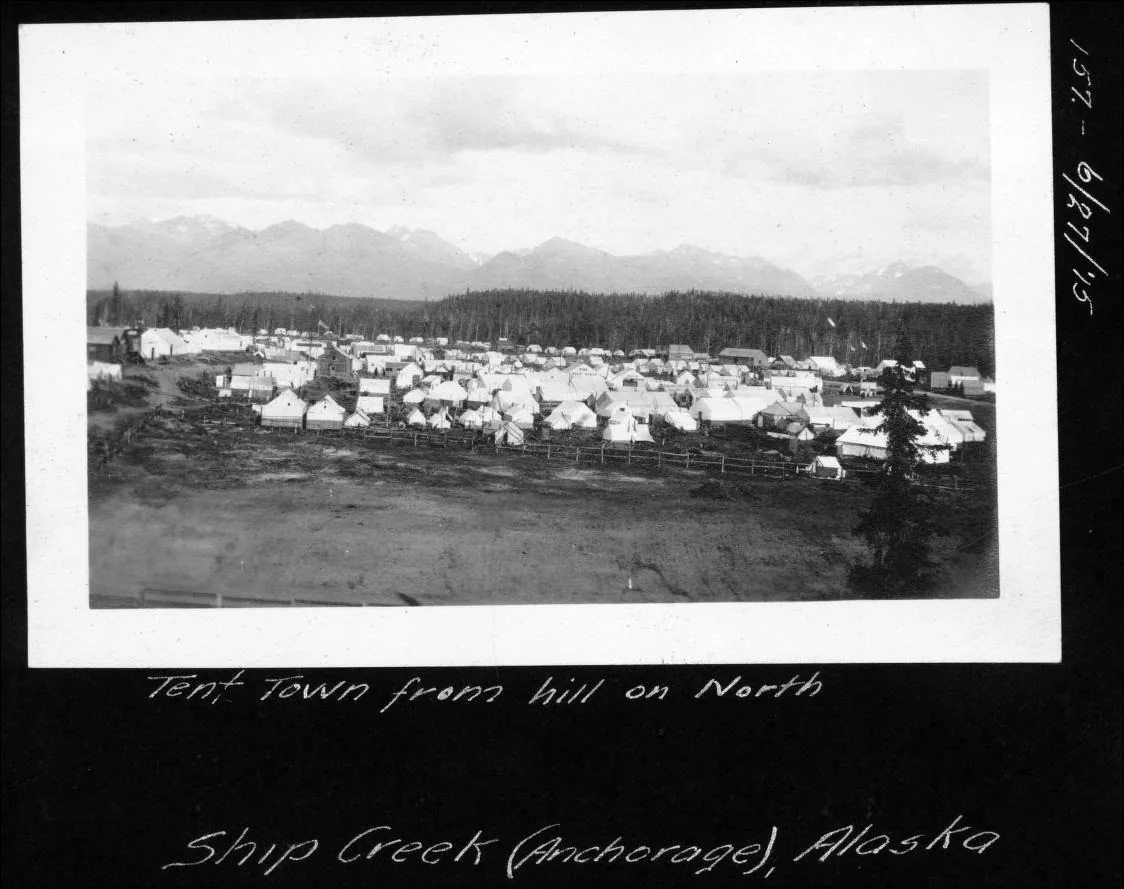
- View from Hill on the North of Tent Town at Ship Creek
August Cohn, Alaska Engineering Commission; original at Anchorage Museum, presented by the Library of Congress. Primary-source photograph.
- Plat of Anchorage Townsite, 1915
Surveyed for the Alaska Engineering Commission and presented by the Anchorage Museum. Primary-source map.
- Anchorage: A Brief History
Alaska Office of History and Archaeology. Supports Dena’ina seasonal use at Ship Creek and the federal townsite context. Secondary source.
- The Naming of Anchorage: A Safe Place to Be
David Reamer for Visit Anchorage. Prints the nine vote rows, Qatuk’e’usht, its English gloss, and broader-area association. Secondary source.
- Stewardship of the Land and Community
Anchorage Museum, 2021. Prints Qatuk’ek’usht, presents the Ship Creek forms, and credits its map to James Kari and James A. Fall. Educational secondary source.
- Dgheyay Kaq’: The Mouth of Ship Creek
Anchorage Museum. Supports the place-specific name and gloss for the creek mouth.
- Dena’ina Ełnena
Anchorage Museum. Supports the treatment of Dena’ina place names as specific cultural, environmental, historical, and spiritual relationships with place.
Record practice. Published by alaska.city. Sources and claims are revised in place when filed evidence changes. This edition was reviewed August 11, 2026.